The Beginning of the Originless Age
On AI Video, Avengers: Doomsday, HBO's Harry Potter, and the Collapse of the Original
A strange thing happens when you open Instagram these days. You can watch scenes from two of the most anticipated releases of the coming year, neither of which has been filmed.
One of them is Avengers: Doomsday, the thirty-ninth film in the Marvel Cinematic Universe, set to open on December 18, 2026. Robert Downey Jr. returns, but not as Tony Stark; he plays Doctor Doom, the franchise's new central antagonist. The second is the HBO television adaptation of Harry Potter and the Philosopher's Stone, which premieres exactly a week later on December 25—an eight-episode first season with Dominic McLaughlin as Harry, John Lithgow as Dumbledore, Paapa Essiedu as Snape. Its teaser, released on March 25, became the most-watched trailer in HBO Max's history, accumulating 277 million views in its first forty-eight hours.
Between them, these two properties will open the English-speaking world's Christmas week: the American blockbuster and the British literary revival, Hollywood and London, Marvel and Rowling, the two great engines of Anglophone franchise culture running at full steam. Both are, at the moment I write this, still in post-production. Neither has released substantial footage. And yet both are everywhere already, in versions that do not exist.
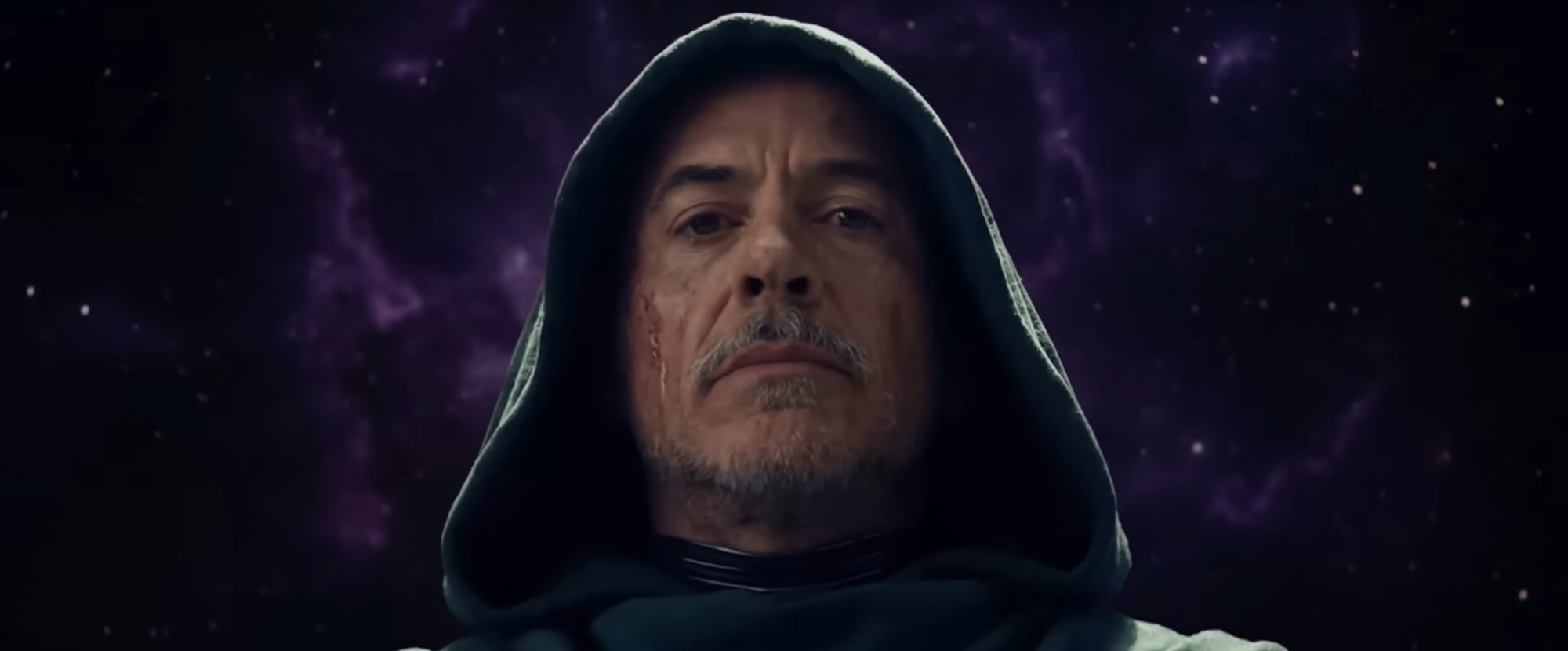
On Instagram, a blue-checkmarked account called @evolving.ai has been circulating AI-generated scenes from Avengers: Doomsday. One clip shows Downey Jr.'s Doom facing what the caption describes as a "Council of Kangs"—a synod of variant Jonathan Majors figures, recognizable from his turn as the villain in Ant-Man and the Wasp: Quantumania. Another shows a weathered Tony Stark, now in hooded robes, staring out at a nebula. The comments register a mixture of excitement, disbelief, and an increasingly familiar kind of procedural exhaustion: is this real? is this official? where is this from?
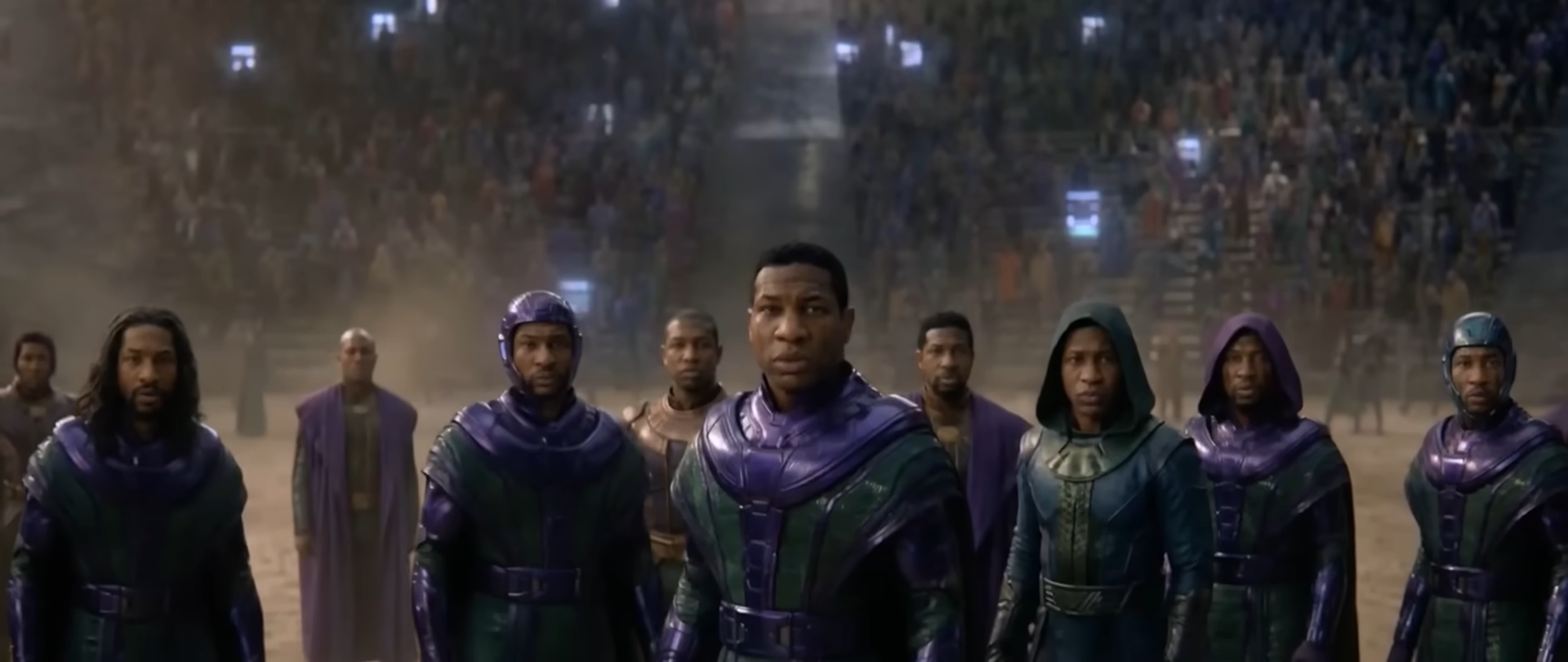
It is not real. More importantly, it will never be real. The "Council of Kangs" is a concept drawn from the Marvel comics—specifically the early-2000s Kang Dynasty storyline by Kurt Busiek—but the film abandoned that thread entirely when Jonathan Majors was convicted of assault and harassment in December 2023. The multi-film Kang arc that had been announced as the MCU's next decade was quietly wound down. In the Doomsday that will actually screen this Christmas, Doom stands alone; there is no Council. The clip is not a leak of a shelved scene; it is a fully synthetic rendering of a confrontation that was never filmed, for a storyline that was cancelled, in a movie whose villain has changed.
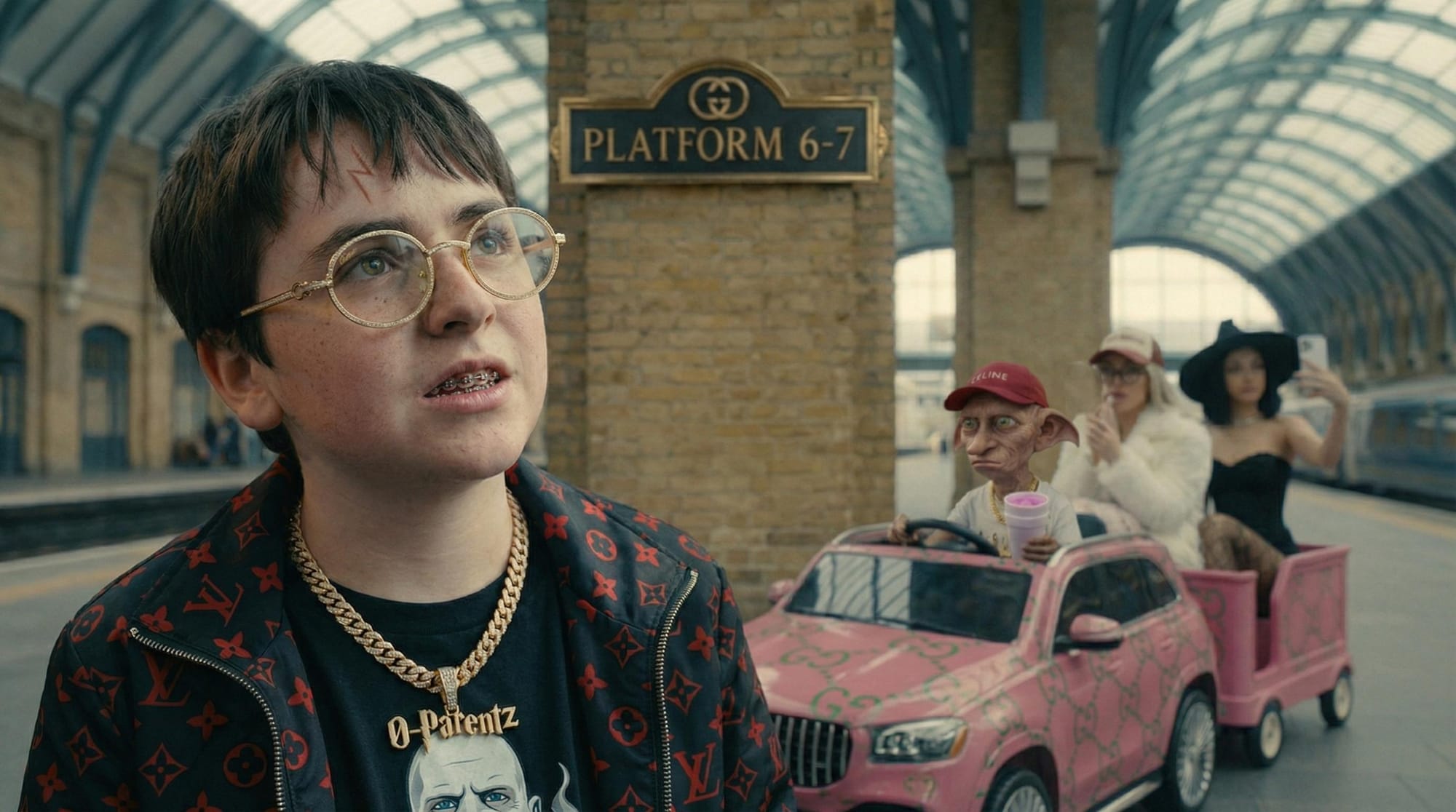
The HBO Harry Potter has attracted a parallel ecosystem, one of whose more elaborate expressions is a series called Dripwarts, produced by an account named @unhinderedstudios. It accumulated, by the studio's own count, something like 250 million views in a week. The premise is baroque in the specific way internet culture is baroque: the Hogwarts Express is replaced by a Maybach; Dumbledore wears monogrammed Gucci and holds a gold-plated rifle; Harry wears a Louis Vuitton bomber and a chain that reads "0-PARENTZ"; Ron wears one that reads "WEZ SIDE." The creators call it a parody, and some of the compositions are funny in ways that argue for the label. What the label does not capture is the photorealism. These are not illustrations of an idea; they are video, rendered to the standard of contemporary streaming prestige, in which the faces of actors long dead are reanimated and the faces of working actors are doubled and costumed at will.
Taken together, the videos of Doom and the videos of drippy Dumbledore look strange when you examine them closely. They look less strange the further away you stand. And they look, for practical purposes, indistinguishable from official promotional material when encountered in the wild: one swipe away from the actual trailer, in the same feed, from accounts with blue checkmarks.
The enabling technology is a category, not a single tool. Over the past twelve months, several generative video models have arrived at approximately the same perceptual threshold: ByteDance's Seedance 2.0, Google's Veo 3.1, OpenAI's Sora 2, Runway's Gen-4 family, the open-weight WAN series, Kuaishou's Kling. Their internal details differ. Their outputs, for most purposes and most viewers, do not. Each generates multi-shot video of synchronized sound and motion from a text prompt or a reference image; each produces results that have, in early 2026, broken through the last perceptual markers that previously let viewers flag AI content unconsciously—the melting faces, the floating limbs, the logical errors in lighting. The markers are gone. What remains is a category of tool that produces convincing cinema at the scale of an individual laptop.
This convergence is itself worth noticing. When ByteDance released Seedance 2.0 in February, complaints from Hollywood rights-holders prompted the company to deploy unusually aggressive filters: realistic human faces were blocked as reference images, specific IP characters were refused, the planned global rollout was paused. For a brief moment this looked like a responsive corporate safety apparatus doing its job. The moment passed quickly. The outputs now circulating—Dripwarts among them—are demonstrably not the work of a model that blocks faces or licensed characters, which means they are being generated somewhere else in the category. The enforcement gap is structural. If one frontier model adds filters, three others remain. If all of them add filters next year, open-weight models inherit the frontier the year after that. The frontier itself is not a thing anyone now knows how to govern; what is governed is a particular product, in a particular jurisdiction, for a particular moment.
That is what has changed. Not the existence of fan-made content—that is older than cinema—but the collapse of a perceptual signature that had, until very recently, let viewers maintain an automatic distinction between an imagined scene and a recorded one, combined with the structural impossibility of containing the generation of that content at the point of origin.
It is tempting to read these clips as the latest species of fan art, and to place them in a long lineage: fan fiction, mash-up trailers, cosplay photography, the elaborate architectural renderings of Hogwarts produced by devoted hobbyists. That lineage is real. But something has shifted that the framing does not capture.
Fan art, in its previous forms, was marked. A fan-made trailer used visibly repurposed footage from other films. A cosplay photograph was a photograph of a person in costume. A fan illustration was, unambiguously, an illustration. Each form advertised its secondariness in the same gesture that produced it. The distinction between the authorized source and the affectionate derivative was not merely a legal distinction; it was a perceptual one, preserved in the medium.
The new objects do not preserve that distinction. A synthetic scene from Avengers: Doomsday does not present itself as fan art; it presents itself as a scene from Avengers: Doomsday. Its texture, grain, color grading, and camera behavior have been trained on actual cinematic footage, and it produces outputs that occupy the same perceptual register. The frame around it—the Instagram caption, the account name, the hashtag—is the only thing telling you what it is, and those frames are easily cropped, reposted, or ignored.
The consequence is that the order of encounter has reversed. Under the old regime, a viewer saw the official film first and the fan art afterward; the fan art was read through the original. Under the new one, a viewer frequently sees the synthetic version first—often weeks or months before any official footage—and encounters the eventual original as a kind of variant of the version that has already colonized their imagination. The copy precedes the original.
This is not an especially novel claim in the abstract. Jean Baudrillard was writing about the "precession of simulacra" in 1981, arguing that maps increasingly precede the territories they describe and that models generate the reality they appear to represent. What is new is the concrete form. Baudrillard's examples—Disneyland, the Gulf War, DNA as code—all preserved a kind of theoretical perch from which the observer could still say: this is the simulacrum, and that is what remains of the real. The objects in question were always framed, institutional, mediated at a distance. The observer, the critic, the analyst retained a position outside the synthetic field.
That position is no longer stable. Synthetic clips of Harry Potter or Doomsday are indistinguishable from official ones not only for the casual viewer but for the careful one; the discriminatory techniques that separated them have been systematically absorbed by the generative model. The perch is gone, and with it the old critical posture.
The studios have noticed. Warner Bros. Discovery and the Walt Disney Company are both parties to an escalating set of legal and technical moves aimed at reinforcing what the industry calls "authorized provenance"—watermarking, cryptographic signing at the point of capture, the C2PA authentication standard, selective licensing agreements with AI platforms. These are meaningful. They are also slow, and they are answered by the enforcement gap described above. HBO's Harry Potter teaser was signed and watermarked at release; the Dripwarts videos were not. The first circulated on HBO's official channels; the second circulated everywhere else. The first required a century-old production infrastructure: casting across 32,000 auditioning children, location scouting, set construction, visual effects pipelines, principal photography at Leavesden Studios. The second required a laptop and a prompt.
The asymmetry is what matters, and it is permanent. The economic structure of the prestige franchise—the long development cycle, the carefully managed teaser-to-trailer-to-release rollout, the cultural preparation of an audience over months—depends on a form of scarcity that the technical conditions have just eliminated. Marvel spent nearly five years managing public anticipation for the two-film arc now arriving as Doomsday and Secret Wars. An anonymous account can generate a new "scene" from the film in four minutes.
This is, to be clear, a story about entertainment. But it is not only about entertainment. The two cases I have described are noteworthy because they are benign—no one is seriously harmed by a misattributed Marvel clip or a Gucci-clad Dumbledore—and because they are, for that reason, a useful leading indicator. If the perceptual infrastructure required to distinguish filmed reality from synthetic reality has collapsed for the most heavily protected, most legally surveilled, most resourced properties in Anglophone culture, it has collapsed for everything else too. Local journalism. Political speech. Court evidence. Scientific publication. The image of your uncle.
What is happening to Avengers: Doomsday and to the HBO Harry Potter will happen to a presidential debate, a police body-cam clip, a corporate earnings call, a private video message from someone you love. It is already happening. The Marvel and HBO cases are simply loud enough, branded enough, and frivolous enough that we can see the mechanism without being distracted by its consequences.
There is a case to be made that none of this matters. People have always understood that media representations are constructed; they have always engaged imaginatively with unrealized possibilities; they have always traded in rumors, fakes, forgeries, and fictions. The synthetic clip is just the latest in a long technical series, the argument goes, and the culture will adapt, as it adapted to Photoshop, to deepfakes, to the doctored photographs of the Soviet nomenklatura.
I want to resist this argument, though not entirely. It is true that media literacy is adaptive, that publics are more resilient than panicked commentary gives them credit for, and that the history of technology is, to a significant degree, the history of false alarms. But the argument assumes that the relevant adaptation is cognitive—that viewers will learn to recognize the new forgeries as they learned to recognize the old ones. The current threshold suggests otherwise. What has disappeared is not a single detectable marker but the systematic availability of perceptual difference. There is nothing left to recognize.
What will adapt, instead, is the structure of trust itself: what we believe, whom we trust to verify it, and what portion of our ordinary lives we can continue to treat as shared with our neighbors. That is a different adaptation. It is more consequential than adjusting to a new kind of Photoshop.
This essay is the first in a series I intend to write over the coming months, under the working title The Originless Age. I do not think the problem I am describing is widely named yet, in English or any other language, and I suspect that the absence of a name is a significant part of why it remains mostly unaddressed. The ambition of the series is modest: to propose a set of frames, a working vocabulary, and a few lines of thought that I have found helpful in seeing the situation clearly. I am not a technologist. I do not have policy recommendations. I am a reader who has been watching, for several years now, a particular kind of condition become pervasive, and I would like to describe it while the description still seems worth making.
The next essay will take up the philosophical lineage in more detail—what Baudrillard got right, what he could not have anticipated, and what happens to Walter Benjamin's concept of aura when the origin it was grounded in is no longer required. For now: on the 18th of December, a movie will open. On the 25th, a television show. By the time they arrive, you will already have seen them, in forms their makers did not authorize and cannot retract. What you will be watching, when you finally sit down in front of the real thing, is a variant of the version you already know.
I find myself unsure what to call that experience. Not disappointment, exactly. Not déjà vu. Something closer to the feeling of arriving at a place you have only visited in dreams, and discovering that the dreams were more vivid.
— The Originless Age, 01
Next: The Moment the Simulacrum Outran the Original